
First Moments Matter: Transforming Neonatal Care by Welcoming Dads from Day One
By Hannah Bose | 16th June, 2026 |
Building upon the success of our existing award-winning DadPad Neonatal book, which was developed in partnership with Prof Minesh Khashu, Lead Neonatal Consultant at Poole Hospital and with the assistance of National Lottery Awards4All funding, we are excited to announce the launch of a new resource package aimed to further improve the support that is available to dads arriving upon a neonatal unit.
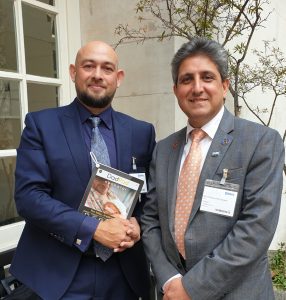
(L-R) Julian Bose, CEO at DadPad, and Prof Minesh Khashu, Lead Neonatal Consultant at Poole Hospital, pictured with the original DadPad Neonatal at the 2019 BMA Patient Information Awards, where the resource was ‘Highly Commended’ in the Innovation category. [Photo courtesy of the BMA]
What is being offered?
Launching initially this month across our eight pilot neonatal units in England, the DadPad Neonatal (DPNN) app encapsulates a simple but powerful intervention: providing an interactive welcome to dads from the moment that they arrive on the unit, equipping them with clear, accessible information, and guiding them gently into this new environment. Supported by a companion booklet, the resource package gives dads the confidence, knowledge and emotional understanding needed to be able to engage meaningfully in their baby’s care.
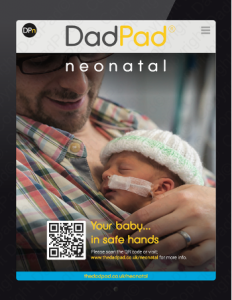
Upon admission to the unit, dads will be first provided with the DPNN booklet: a quick-read, visually-engaging guide designed to meet them where they are. It seeks to meet core initial needs, such as the provision of an overview of this new situation together with guidance on what to expect across the first few hours and days. This is coupled with some practical suggestions of ways in which dads can support and care for themselves, their baby and their baby’s mum at this critical stage.
Importantly, the booklet also acknowledges and highlights to dads their own emotional experience, aiming to normalise potential feelings of fear, helplessness and uncertainty.
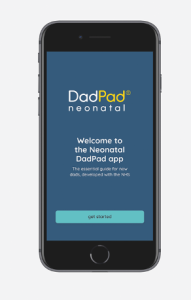
Alongside this, the DPNN app aspires to provide more detailed, specialised and longer-term support. As well as supplementary information on a range of topics – including neonatal medical equipment, developmental care, multiple births, longer-term conditions, and going home with your baby – it also signposts dads to trusted sources of information, local services, and other initiatives linked to the unit.
The app is enabled for both phone and iPad/tablets and has additional elements, such as localised in-app community groups, which provide dads and families with the opportunity for collaborative peer support, and staff/dad interactions. Units can also send out reminders of opportunities for dads to attend local support groups, classes and other services for further assistance, via the push notification feature.
The initiative will also be looking to evolve. Supported by a further National Lottery grant, the new resource bundle will be expanding in time to include multiple language options within the app, more inclusive imagery, and a dedicated version for LGBTQI+ non-birthing parents.
Why is this needed?
For many new dads, the neonatal unit is not just unfamiliar, but also overwhelming. For many, it will be their first experience of a clinical maternity environment. The majority will arrive unexpectedly, in emotionally-heightened circumstances, with a baby that is premature and/or unwell, and a partner who may be recovering from a physically and/or emotionally traumatic birth. The situation is therefore far from ideal, and it’s not surprising that – at this pivotal moment – dads are commonly unsure of their role, their place, and how they can help.
Where’s the evidence?
Whilst mums are – rightly – supported and involved throughout the perinatal period, dads often report feeling missed, ignored or overlooked by the healthcare professionals supporting their new family, in favour of mum, seeing her as the primary caregiver.
The evidence is clear, though: where dads are supported early in their transition to fatherhood, outcomes improve.
Research specifically into Family Integrated Care (FICare) within the neonatal setting demonstrates further that, when parents are actively involved in neonatal care, babies experience better developmental outcomes, shorter hospital stays, and improved bonding and attachment.
Crucially, FICare is being actively recommended, developed and/or focused upon within neonatal units across the UK, and also promoted and supported by lead neonatal agencies and organisations, such as the British Association of Perinatal Medicine (BAPM) and Bliss.
However, successful implementation of the model depends on both parents feeling confident in their role and capable of participation. Without early and intentional engagement, many dads miss the chance to fully participate in FICare, limiting not only their confidence and engagement, but also their family’s ability to function as a cohesive and supportive unit, both in the short- and long-term.
What about the cost?
This new, enhanced DPNN resource bundle recognises the financial pressures within the NHS; with a low cost (around £2,000 per unit per year) and a sustainable ongoing finance model that is supported by and integrated within existing charitable partnerships, the programme is designed for long-term viability.
This also creates a model of shared stakeholdership, bringing together dads, staff and support organisations, ensuring that fathers’ voices are heard, staff gain insight, and services evolve in real-time, which will further help improve outcomes.
At its core, then, the DPNN resource is about connection: between dads and babies, partners, and professionals. By engaging, involving and supporting dads right from the very start, we can transform their experiences and improve outcomes for families across neonatal care.
To find out more about how the DPNN resource could benefit your neonatal unit, please contact Julian on 07403 274757 or via his email: julian@thedadpad.co.uk.

Hannah Bose
Hannah takes the lead on quality within Inspire Cornwall CIC, which includes keeping an eye on all our content – whether that’s in our resource...