
How can I help my little one learn their numbers?
By Hannah Bose | 20th May, 2026 | 9 minutes read
Today is National Numeracy Day, which gives us a great excuse to share some ideas on how you – as a new dad – can help your child learn their numbers and develop key numeracy skills. The bonus is that you’ll also be building your bond and your relationship with your little one at the same time!
Numeracy has been defined as “the ability to understand and use maths in daily life, at home, work or school” and “having the confidence to use basic maths at work and in everyday life” (National Numeracy). Whether you loved or hated maths at school, you’ll know that having a good basic understanding of numbers and how to use them is going to be a core part of your child’s learning, as soon as they start in education, and it’s a really important skill for them to have.
Why numbers matter
According to the team at National Numeracy, having good numeracy skills “is the best protection against unemployment, low wages and poor health.” (Andreas Schleicher, OECD) – something we’d all want for our children.
Other interesting data from National Numeracy include that:
- people with poor numeracy skills are more than twice as likely to face unemployment;
- there is a clear connection between poor numeracy and poor health, and also a link between depression and poor numeracy;
- 14-year-olds with poor maths skills at the age of 11 are more than twice as likely to play truant from school;
- pupils who start at secondary school with very poor numeracy skills are more likely to face exclusion; and
- children with social, emotional and behavioural difficulties are more likely to struggle with numeracy, even when also considering other factors such as their general ability and their home background.
Some of these might sound a long way off for your little one, but it’s never too early to get core number skills in place, which will help make their school life easier. It’s established that “too many children start to fall behind in maths early on and that failure is compounded over the years” (National Numeracy), so doing all you can to build your child’s confidence with numbers – even if you don’t think you have much confidence yourself! – is an amazing gift to give them. And it’s important to remember that you don’t need fantastic maths ability yourself to help your child develop early numeracy skills – instead, it’s about doing fun and engaging things like encouraging and helping your child to clap to a rhythm, recognise shapes in everyday life, count how many socks they have, or sort their toys by colour.
Camilla Gilmore, Professor in the ESCR Centre for Early Mathematics Learning at Loughborough University has emphasised:
My advice is to have fun with it and make it a natural part of your day: from counting the number of jumps your child can do to playing easy board games.
What should they know and when?
If you want to find out a little more about what numeracy skills your child should be developing before school, there are lots of useful sources of information online – although do always remember that all children are individuals, and not all will meet their milestones at exactly the same age. Having this knowledge to hand is also useful to ensure that the games you’re playing with your little ones is age-appropriate, and that you’re not trying to get them to do something that they’re not yet ready for.
The team at Lovevery have also provided some useful guidance on the main numeracy learning stages in babies and young children:
- Quantity recognition: this skill is one of the first to develop, and usually starts at around 6 months, when babies can often differentiate between larger and smaller quantities or groups just by observation. This skill will continue to develop over the next year or so, helping them to make informed choices (knowing which bowl contains more biscuits) and begin to develop early number language skills;
- Counting by rote: knowing a sequence of numbers (1 to 10, say) is something that children can often do from around 2 years, as they’ve memorised the sequence – perhaps through a song or a rhyme;
- Connecting number words to quantities: as they progress towards 3 years, children should be able to start making the connection between a number (say ‘2’) and what that looks like in real terms (spotting that there are two toy cars in the box). Initially, they will struggle to easily recognise more than 3-5 items in a group, but this skill will continue to develop over time and with practice;
- Cardinality: between the ages of 2 and 4 years, your little one will also be able to start recognising that they can identify the number of items in a group by counting, and that the last number they get to is the total amount in that group.
Further, if you want to start thinking towards school-readiness, National Numeracy indicate that a child aged 5 years and under should be starting to:
- learn about basic measurement, shapes, spaces, positions, numbers, order and patterns
- understand the sequence of numbers
- understand positional words such as ‘in’, ‘on’, ‘outside’ and ‘under’
- develop an awareness of time
- learn number rhymes and songs
There’s also a really interesting blog on the CBeebies Parenting page, which provides useful information on when and how children learn to count.
How can I help?
The fantastic news is that there is LOTS of information and ideas for you online to help you help your child develop their number skills in a really fun way.
One traditional way is to sing counting songs and rhymes with your little one – who can forget classics such as “1, 2, 3, 4, 5, Once I caught a fish alive” and “One, two, buckle my shoe”? – And if you have forgotten, YouTube is a great place to search for inspiration! Another lovely source of nursery and counting rhymes is the CBeebies Parenting website – they’ve got a dedicated page for ‘Nursery rhymes and songs’ where you can watch parents (often dads 💙) interact and sing with their babies and toddlers. There are also transcripts under the videos, so you can learn the words as well as the tunes, together with information on how you can enhance your child’s brain development as you sing each song to them (we especially love the video from the ‘Three Little Speckled Frogs’ page).
As your baby gets older and becomes more aware of their surroundings, using number language in your interactions with them will also help their learning. So, for example, when you’re playing together with toys, you could state what colour, shape or size the item is:
- That’s your GREEN car!
- Where’s the BIG teddy?
- Can you find the ROUND brick?
As with all language learning, regular and gentle repetition really does help.
You can also look for shapes, colours and numbers in the wider world – pointing out numbers on doors, shapes on road signs, and colours of cars or clothing is another easy way to keep them learning and engaged without really noticing what’s happening. To find out more about how toddlers start to group objects by their shape from around 2-3 years of age, have a look here, and you can understand how they learn the difference between large and small here.
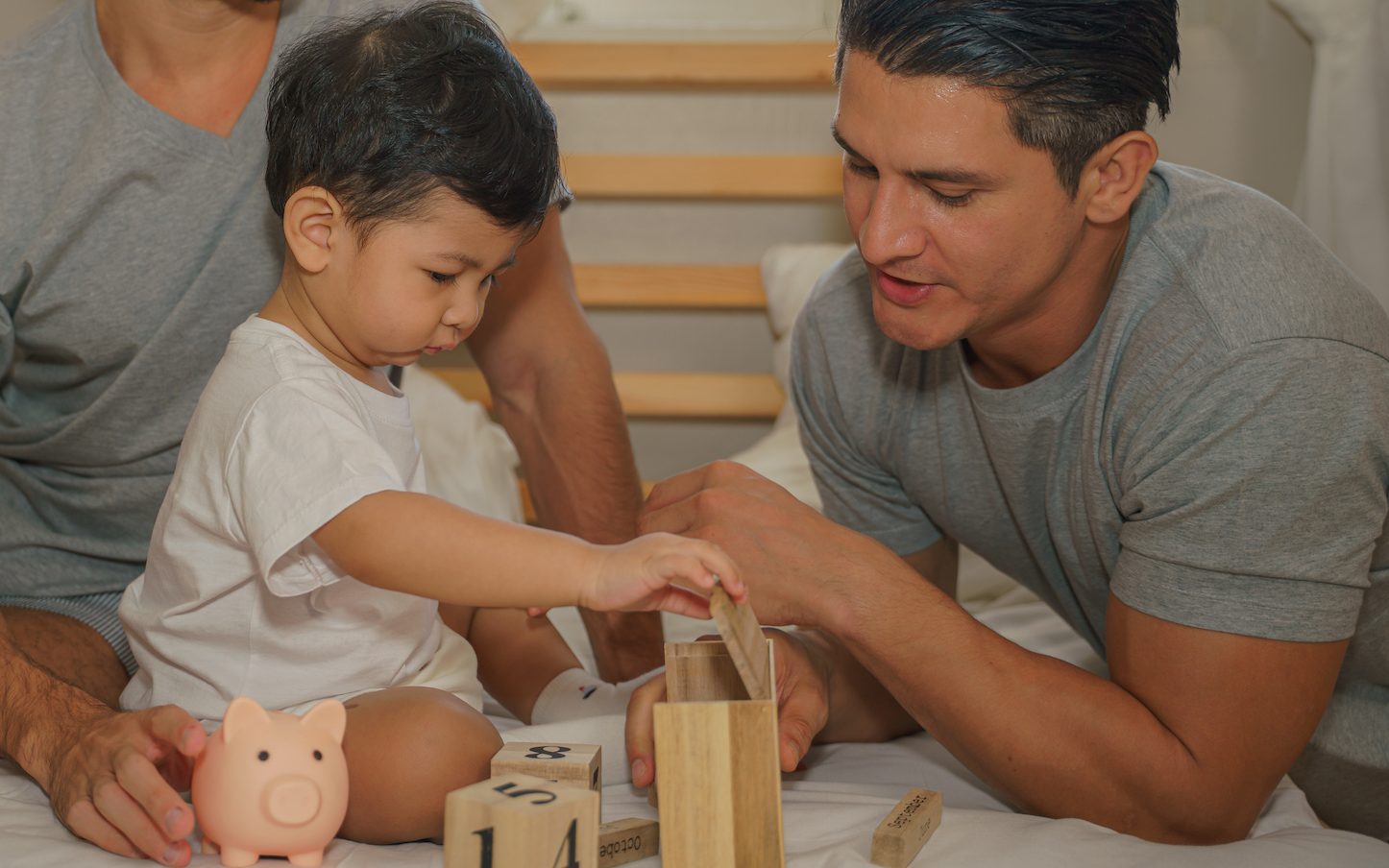
Once your child starts to get an idea of numbers and counting, this is again something that you can integrate into all your daily activities – counting toes and fingers when changing a nappy or getting dressed, cars parked in the street, or bricks in a tower are some ideas for starters. Sorting into groups is also a fun way to help numeracy skills when playing – toys like coloured wooden blocks are great for this, as they enable you to ask your child to do things like “find all the red bricks”, or “can you make a group of blue bricks and a group of yellow bricks”. As they get more confident, you could pre-sort bricks into groups and help them learn to count and then recognise whether there are two or three bricks in each pile.
Obviously, there are also lots and lots of specially-designed educational toys out there for babies and toddlers, too, but you don’t really need anything complicated or expensive to help them learn the basics. Simple shape-sorting puzzles are good, as they enable little ones to really feel what a triangle, a circle or a square is, and again they give you the opportunity to reinforce the number language as you play together. You could also use colourful card games – especially those with either numbers shown on them or individual items to count – to help their learning through play, or even make some cards yourself. And, when they get a bit older, simple board games like ‘Snakes and Ladders’ all help number recognition, counting-on, and other number words like ‘up’ and ‘down’.

Hopefully the ideas set out here will give you some inspiration and confidence to get started, but there are lots more ideas online to help you. As well as the ones already linked in this blog, we also recommend:
We’ll finish with this inspiring quote from National Numeracy:
The importance of basic numeracy skills in life shouldn’t be underestimated. From counting, to telling the time, to planning a simple budget, an early familiarity with numbers, combined with the right attitudinal framing (i.e. that we can all improve) is a vital foundation for using numbers as an adult.

Hannah Bose
Hannah is Head of Quality at Inspire Cornwall CIC, with a background in law, education, editing and writing.
Hannah Bose's BlogsFurther reading and references
BBC Bitesize (undated) Helping your child learn to count. [online]
CBeebies Parenting (undated) How does your toddler learn the difference between large and small? [online]
CBeebies Parenting (undated) How toddlers start grouping things by shape. [online]
CBeebies Parenting (undated) Numbers and counting for preschoolers: When do children learn to count and how to help them. [online]
CBeebies Parenting (undated) Nursery rhymes and songs. [online]
Dwarkaram, Poonam (2025) More Than Numbers: How Early Numeracy Shapes a Child’s Future. [online]
Lovevery (undated) Numbers. [online]
National Numeracy (undated) Activities for children [online]
National Numeracy (undated) What is numeracy? [online]
National Numeracy (undated) Why is numeracy important? [online]