

How does having an attuned early relationship help support my baby’s development?
By Hannah Bose | 5th June, 2026 | 8 minutes read
This year’s Infant Mental Health Awareness Week puts the focus on attunement, highlighting how attuned early relationships help to support babies’ development.
Attunement is a concept which is flagged up by lots of leading infant mental health and early childhood experts – including in particular The Royal Foundation Centre for Early Childhood – as being crucial in helping support a child’s social and emotional development.
What is attunement?
The Parent-Infant Foundation have defined attunement as:
…the ability to tune in and connect with others on an emotional level. It is important for everyone, but particularly for babies and their carers.
The Royal Foundation explain further that:
Emotional attunement involves noticing, understanding and responding to another person’s emotional stage in a sensitive and appropriate way. When adults are emotionally attuned to babies and young children they notice cues, validate children’s emotions and appropriately respond to them.
Why is attunement important?
The most important thing which attunement offers a child is the feeling of being loved, safe and understood. An attuned relationship helps our little ones get the very best start in life, by learning how to regulate their emotions, which helps to support their longer-term mental health.
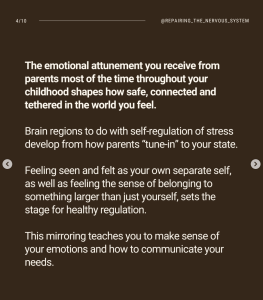
To help us get to grips with some of the science behind this, Jessica Maguire, an expert in the nervous system and vagus nerve, has noted:
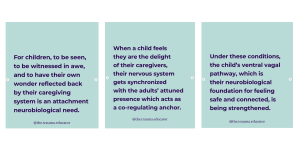
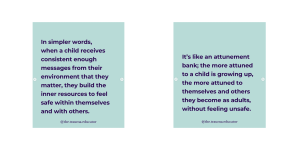
Efthymia Kli, a trained somatic coach and trauma educator, adds to Jessica’s comments and conclusions as follows:
Surely it’s too early to start trying to develop this with a baby?
The short answer to this one is easy: no. We know, for example, that in the very earliest days, months and years of life, a baby’s brain is more malleable (sometimes called brain plasticity) and able to change, and therefore the connections that the brain forms in reaction to experiences and interactions from Day One and in our First 1001 Days are especially important.
The Royal Foundation Centre have confirmed (2026, p7) that:
Positive early interactions develop social and emotional skills: these underpin health and happiness throughout our lives.
There is clear evidence that warm, sensitive early relationships support the development of social and emotional skills. These skills are linked both to wellbeing in early childhood, and to improved outcomes across our lives…
All these skills have their roots in early childhood but continue to develop throughout life.

Jessica Maguire has also explained that this ability to ‘learn’ stress-recovery skills actually starts before baby is even born:
The branch of your vagus nerve that helps you recover from stress, regulates your heart rate and breathing rate, and helps you to connect with others, begins to develop in the final trimester of your mother’s pregnancy and continues into your teenage years. Its development comes from breastfeeding, touch, smiling faces and cooing voices. This branch of the vagus nerve develops by internalising your caregivers’ co-regulation and learning how to calm your nervous system after stress, on your own.
How do I build an emotionally-attuned relationship with my little one?
Having learnt the importance of building an emotionally attuned relationship with our babies, the good news is that it’s a relatively simple thing to do.
The Royal Foundation Centre have effectively set out a three-step approach to tuning into your child:
- Start by watching and listening to your child. How are they behaving? What expressions are they showing? How do you think they are feeling? This is often identified as reading their cues;
- From there, it’s important that we show our child that we have understood them, and we can do this by naming the feeling back to them. These are our responses, which can be both verbal (spoken) and non-verbal;
- Finally, we can help our child manage the feelings that they are getting, so that eventually – with time and as they grow older – they will learn to manage their own feelings and recognise different emotions in others, too.
You can understand a bit more about this process via this short but excellent video from The Royal Foundation Centre.

How do I actually do this in practice?
There are lots of suggestions online for ways in which we can develop and improve our ability to complete the three-step attunement process suggested above. Again, The Royal Foundation Centre is a great place to start.
Cues: Even though they can’t speak, even the smallest of babies is soon able to communicate to us their emotional needs and feelings; we just need to practice recognising these. The Royal Foundation Centre suggests that cues might include: “facial expressions, body posture, eye gaze, sounds, words and movements.” We therefore need to be alert for both verbal (spoken or noise-based) and non-verbal cues, which might include gestures and actions.
Responses: Ultimately, this means that we need to react and respond to our child’s emotional cues in a reflective and supportive way. In terms of our reaction, this might involve mirroring emotions back to them, such as smiling and laughing back to and along with a child who is clearly happy and joyful, and slowing down and reflecting a child’s sadness in our own facial expression. This is a way to help your child learn to recognise emotions. There are also lots of ways we can respond to their emotions, too, such as naming those emotions – “Isn’t this fun!”, “You look like you’re feeling sad?” or “I can tell that something has upset you” – which again helps them to recognise different emotions in themselves and to learn the words for those feelings.
Managing feelings: We’ve all been there; being in a state of feeling all the feelings and suddenly it just gets too much. With little ones, then, our job is to notice our child’s emotional stage (see above) and then help them return to a state of calm. Importantly, this is less likely to happen if we react inappropriately – such as by trying to distract our child, rather than acknowledging and helping them work through their emotions, or by treating their frustration or upset as bad behaviour to which we offer a harsh response. Letting them know that you can see why they’re feeling a certain way, offering words of reassurance and understanding to soothe, or providing guidance on (for example) how to calm down (such as “You could try taking big breaths into your tummy now”) will all help them to not only feel better in the moment, but also learn key skills for future reference.

As our children grow, we can have more conversations with them about feelings. Age-appropriate books are a great place to start – we can talk together about how a character might be feeling and why at different stages in the story, and also look for cues in pictures of the characters on the pages. In this way, we will be not only enjoying story time together, but also developing our child’s emotional language and helping them think about feelings and emotions in others, as well as themselves. Your local library is a great place to start!

But I really don’t think I’m up to it…
For most of us, following this process may take some practice, especially if it’s something we did not experience ourselves during childhood.
Further, if we – as a parent – are experiencing additional stresses, such as mental health difficulties or other life pressures, this can also make it trickier for us to consistently do what needs to be done to attune with our children.
However, it’s reassuring to note that research indicates that: “The goal isn’t perfect attunement. It’s a general pattern of responsiveness over time.” (Good Parenting Science, 2026), that “a child will learn healthy self-regulation with ‘good enough’ parenting.” (Maguire, 2026) and “children… actually gain helpful learning when adults do not get everything right, provided the ‘ruptures’ in the interactions are repaired by a return to sensitive, responsive care.” (Royal Foundation Centre for Early Childhood, 2026, p6).
It may be that – because of some of the points noted above – you may feel that you would benefit from some extra support in being able to emotionally attune with your baby. If that’s the case, do please speak to your Health Visitor or someone at your local Family Hub about whether there are any suitable courses or other forms of support available to you locally.
And, as with most things in life, the more we practice, the better we’ll get! Recognising and responding to our baby’s emotional cues will become easier, we’ll get better at ‘knowing’ their individual ‘tells’ and we’ll also get better at helping them manage their emotions. Don’t be afraid to give it a try!

Article last reviewed and updated by DadPad: 5th June 2026

Hannah Bose
Hannah is Head of Quality at Inspire Cornwall CIC, with a background in law, education, editing and writing.
Hannah Bose's BlogsFurther reading and references
Good Parenting Science [@goodparentingscience] (01 Jun 2026) What Actually Builds a Secure Attachment With Your Child. Instagram [online]
Kli, Efthymia [@the.trauma.educator] (23 May 2026) Learning to practise self-attunement, over time… Instagram. [online]
Maguire, Jessica (undated) How Parental Relationships Shape Your Nervous System and Stress Recovery. [online]
Maguire, Jessica [@repairing_the_nervous_system] (18 May 2026). The brain and vagus nerve, like the rest of your body… Instagram. [online]
Parent-Infant Foundation (undated) First 1001 Days Movement: Overview. [online]
Parent-Infant Foundation (2026) Infant Mental Health Awareness Week 2026 Communications Pack. [online]
Royal Foundation Centre for Early Childhood (undated) Science Briefing: Noticing and navigating feelings. [online]
Royal Foundation Centre for Early Childhood (2026) Noticing and navigating feelings. [online]
Royal Foundation Centre for Early Childhood (2026) Science Briefing: How we grow an emotionally healthy brain. [online]